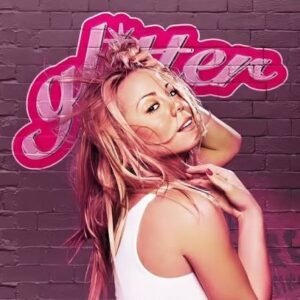
Twenty-five years after Glitter, one of the strangest chapters in Mariah Carey’s career is coming full circle.
“Loverboy” was supposed to introduce a new era. Instead, its journey involved a disputed sample, Jennifer Lopez, Tommy Mottola, a last-minute reconstruction, weak radio support, an aggressively discounted physical single and one of the most turbulent promotional campaigns of Carey’s career.
Yet despite everything surrounding it, “Loverboy” became the best-selling physical single in the United States in 2001, peaked at No. 2 on the Billboard Hot 100 and earned an RIAA Gold certification.
Now, as the 25th anniversary of Glitter approaches, the song has another unusual twist.
The original “Firecracker” version — the recording Carey intended the world to hear before the infamous sample dispute — has accumulated millions of streams since finally being released on The Rarities in 2020. And under modern RIAA rules, those streams can matter to the certification history of “Loverboy” itself.
Potentially, they can matter to Glitter, too.
“Loverboy” was supposed to launch a new Mariah era
In 2001, Mariah Carey was beginning one of the biggest professional transitions of her career.
After leaving Columbia Records, she signed a massive recording agreement with Virgin Records and prepared Glitter, a soundtrack accompanying her first starring film role.
“Loverboy” was selected as the project’s lead single.
But the song originally sounded considerably different.
Carey and producer Clark Kent had built “Loverboy” around a sample of “Firecracker,” by Japanese electronic pioneers Yellow Magic Orchestra.
Then Jennifer Lopez released “I’m Real.”
And it used “Firecracker.”
The incident would become one of the most infamous stories of Carey’s career. Carey had recorded her original version of “Loverboy” using the sample before Lopez’s song was released. Contemporary reporting later described Carey as devastated when she discovered that “I’m Real,” from Lopez’s J.Lo album, was using the same distinctive musical source.
The connection became particularly controversial because Carey had recently left Sony Music, which was headed by her former husband Tommy Mottola, following an increasingly difficult professional and personal relationship with the company.
Carey believed information about her unreleased Glitter material had reached Sony. The circumstances surrounding the competing use of the sample have been disputed over the years, but the practical consequence was undeniable: Lopez’s album was arriving first.
Carey abandoned the original production.
Months after recording “Loverboy,” she returned to the studio and reconstructed the song around “Candy,” Cameo’s 1986 hit. Cameo even returned to the studio to contribute newly recorded vocals.
That became the “Loverboy” the public heard in 2001.
The “Firecracker” version disappeared into the vault.
Then came the release chaos
Even after “Loverboy” had been rebuilt, its launch was anything but straightforward.
The song arrived at radio in June 2001, ahead of its commercial single release the following month. Despite the enormous publicity surrounding Carey’s move to Virgin, radio support was relatively weak.
“Loverboy” debuted at No. 79 on the Billboard Hot 100 and gradually climbed the chart, but without strong airplay it lacked one of the major components needed for a No. 1 hit.
Then Virgin made an extraordinary commercial move.
The physical single was heavily discounted, famously selling for just 49 cents at some retailers.
Sales exploded.
“Loverboy” jumped from No. 60 to No. 2 on the Billboard Hot 100, one of the largest leaps into the chart’s top tier at the time. Destiny’s Child’s “Bootylicious” held it from the No. 1 position.
The result has sometimes allowed “Loverboy” to be remembered as a disappointment because it failed to continue Carey’s extraordinary record of chart-topping singles.
Its sales tell a rather different story.
“Loverboy” sold approximately 570,000 physical copies in the United States during 2001, making it the best-selling single of the year in the country. It also spent four weeks at No. 1 on Billboard’s Hot Singles Sales chart and reached No. 1 on the Hot R&B/Hip-Hop Songs chart.
On August 14, 2001, the Recording Industry Association of America certified “Loverboy” Gold.
Twenty-five years later, that certification has never been updated.
How much has “Loverboy” actually sold worldwide?
The physical single is only part of the story today.
Mariahpedia’s Worldwide Singles Sales database combines physical sales, digital downloads and streaming-equivalent sales to estimate the modern worldwide commercial performance of Carey’s catalogue.
As of 2026, Mariahpedia estimates “Loverboy” at approximately 1.14 million equivalent single sales worldwide, consisting of:
- 807,500 physical singles
- 162,500 digital sales
- more than 25 million tracked streams
- 1,139,014 total equivalent single sales
There is an important caveat to those streaming figures.
Unlike most of Carey’s catalogue, the Glitter soundtrack — including the familiar 2001 version of “Loverboy” — was not made available on streaming platforms until May 22, 2020, almost 19 years after the album’s original release.
For most of the streaming era, Glitter simply was not there.
That gives “Loverboy” a dramatically shorter streaming history than many other Carey singles, particularly songs from albums that had been available digitally for years.
It is also important to distinguish Mariahpedia’s worldwide equivalent-sales estimate from an RIAA certification. The RIAA counts eligible consumption within the United States only, so a worldwide total of more than one million equivalent sales does not itself prove that “Loverboy” is eligible for Platinum certification in America.
But the commercial life of “Loverboy” did not end when physical singles disappeared.
Streaming gave it another one.
And in 2020, streaming gained a second “Loverboy.”
Nineteen years later, Mariah finally released “Firecracker”
When Carey released The Rarities in October 2020, fans finally heard the recording at the centre of the controversy.
There it was:
“Loverboy (Firecracker — Original Version)”
The version buried since 2001 was officially part of her catalogue at last.
It also created an interesting certification situation.
“Firecracker” is not a completely unrelated song that happens to share the “Loverboy” name. It is explicitly released and identified as the original version of “Loverboy.”
That distinction matters.
Under Mariahpedia’s MaRIAA Vault, the RIAA’s current Digital Single Award rules explain that both downloads and qualifying on-demand audio and video streams can count toward a single’s certification. The current conversion formula is:
150 qualifying on-demand streams = 1 unit
And crucially, the RIAA states:
“All versions count once toward certification.”
In other words, alternate versions of the same single do not necessarily have to build completely separate certification histories.
That means qualifying U.S. consumption of “Loverboy (Firecracker — Original Version)” can count alongside other eligible versions of “Loverboy” when the current rights holders submit the title for an updated RIAA audit.
That Gold award from 2001 does not have to remain frozen in 2001.
Why streaming “Firecracker” now actually matters
This is where the 25th anniversary becomes interesting.
For fans, streaming “Firecracker” may feel like choosing an alternate version of a song they already know — or finally giving the version Carey originally intended its moment.
From a certification perspective, however, those streams can have a practical value.
Every qualifying U.S. on-demand stream adds consumption that can be included when “Loverboy” is next submitted for certification.
Mariahpedia already estimates the song at more than one million equivalent units worldwide. Again, that cannot be directly translated into an RIAA award because only U.S. consumption qualifies, but it demonstrates that the song’s commercial history has continued well beyond the physical-single era.
The RIAA threshold for a Platinum single is one million U.S. units.
Whether “Loverboy” has already accumulated enough eligible American consumption to reach that threshold cannot be determined from publicly available worldwide figures alone. The complete qualifying data would ultimately need to be assembled and audited when the current rights holders request certification.
But every legitimate U.S. stream of “Firecracker” can move that total in the right direction.
And that is where Glitter 25 could make things even more interesting.
Could “Firecracker” also help Glitter?
Under the modern RIAA system, album certification no longer depends exclusively on people purchasing an album.
Album sales, individual track sales and qualifying on-demand streams are converted into album-equivalent units.
The RIAA currently uses the formula:
1,500 qualifying on-demand audio or video streams = 1 album unit
10 track sales = 1 album unit
The organisation also allows sales of different album configurations to be combined for certification purposes.
That creates an intriguing possibility for the 25th anniversary of Glitter.
If “Loverboy (Firecracker — Original Version)” is formally incorporated into an eligible anniversary configuration of Glitter, qualifying consumption of the track could potentially contribute to the soundtrack’s future album certification calculation as well.
That would mean listening to “Firecracker” could have value in two different certification calculations:
toward “Loverboy” as a single, and potentially toward Glitter through track-equivalent album units.
There is an important distinction here.
The RIAA explicitly confirms that versions can be aggregated for Digital Single Awards. Whether particular streams can also be attributed to a specific album certification depends on the configuration under which the recording is released and the consumption submitted and verified during the certification process.
So the release of a Glitter 25 edition would not magically transfer every “Firecracker” stream ever accumulated on The Rarities into Glitter.
But putting the recording onto an official Glitter anniversary configuration could give its future consumption a direct connection to the album it was originally created for.
And Carey has increasingly been doing something very similar with the archival material in her catalogue.
The songs from The Rarities have been going home
When The Rarities was released in 2020, it gathered recordings from across Carey’s career into a single archival project.
But increasingly, those songs have also been appearing where they historically belong.
As Carey has expanded earlier albums for anniversary releases, recordings previously housed on The Rarities have been incorporated into editions associated with their original eras.
Artistically, it makes obvious sense.
A lost recording from a particular album session is part of that album’s history, even if the public did not hear it until decades later.
In the streaming era, however, there can also be a commercial consequence.
The RIAA’s album programme recognises track consumption when calculating album-equivalent units. Bringing archival recordings into eligible configurations of the albums from which they originated therefore gives those recordings the opportunity to contribute to the continuing commercial life of those albums.
That makes The Rarities an unusual project within Carey’s catalogue.
Carey herself has joked about its status, telling Andy Cohen during an appearance on Watch What Happens Live that “they don’t want to classify it as an album.”
Perhaps that description has become increasingly appropriate.
Rather than functioning only as a conventional standalone album, The Rarities has also served as a vault: a place where previously unreleased recordings could finally enter Carey’s official catalogue before some eventually found their way back to the eras that created them.
And few songs have a stronger argument for going home than “Loverboy (Firecracker).”
It was not merely recorded during the Glitter sessions.
It was supposed to launch the entire era.
Glitter itself has unfinished certification business
There is another reason the anniversary matters.
Glitter was certified Platinum by the RIAA on October 16, 2001.
That certification, like “Loverboy’s” Gold award, dates entirely from the original release period.
The album then spent almost two decades absent from streaming services before finally becoming available digitally in 2020.
That means almost the entirety of Glitter’s modern streaming life has occurred after its last RIAA certification.
RIAA album awards today can incorporate qualifying track downloads and streams alongside traditional album sales. So continued consumption of “Loverboy,” “Lead the Way,” “Never Too Far,” “Don’t Stop (Funkin’ 4 Jamaica),” “Last Night a DJ Saved My Life” and the rest of the soundtrack can contribute to its modern certification total.
A 25th-anniversary edition would therefore be more than an opportunity to revisit an album whose reputation has changed dramatically since 2001.
It could also reconnect Glitter with the modern consumption system from which it was absent for so long.
And adding “Firecracker” would finally restore one of the most important missing pieces of the album’s history.
Twenty-five years later, “Loverboy” gets another chance
There is something unusually fitting about “Loverboy” being reconsidered during Glitter’s 25th anniversary.
In 2001, almost everything that could complicate the release did.
Its original sample appeared on another superstar’s record before Carey could release hers. She rebuilt the single. Radio response was weak. Virgin heavily discounted the physical release. The song surged to No. 2 instead of No. 1. Carey’s health deteriorated amid an overwhelming promotional schedule. The film and soundtrack became engulfed in negative publicity, and Glitter subsequently became shorthand for a supposed career collapse that would follow her for years.
Yet “Loverboy” quietly carried one statistic that never fit that narrative:
it was the best-selling physical single in America that year.
Twenty-five years later, Mariahpedia estimates its worldwide performance at more than 1.1 million equivalent sales — despite the Glitter version not even arriving on streaming services until 2020.
The original recording Carey had to abandon is no longer locked in a vault.
And under the rules governing music consumption today, playing that version is not simply an act of nostalgia.
Streams are consumption.
Consumption becomes equivalent units.
Equivalent units contribute to certifications.
For “Loverboy,” the RIAA’s rules explicitly allow versions to count together toward the single’s certification.
And if “Firecracker” finally takes its rightful place on an eligible Glitter 25 configuration, its consumption could potentially begin contributing to the album it was originally supposed to introduce as well.
Twenty-five years ago, “Firecracker” was removed from Glitter before it ever had the opportunity to do its job.
In 2026, streaming it can finally make a difference.