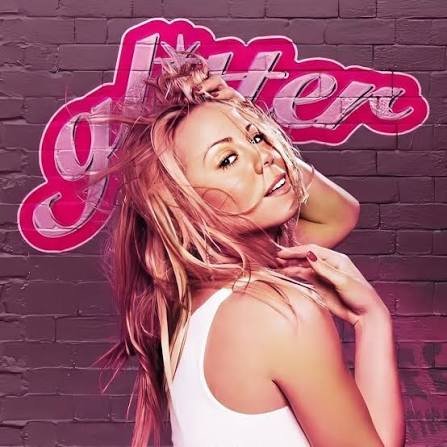
Twenty-five years after Glitter became shorthand for the lowest point of Mariah Carey’s career, the album appears to be preparing for something almost nobody would have predicted in 2001: a full-scale anniversary comeback.
And the rollout may already have begun.
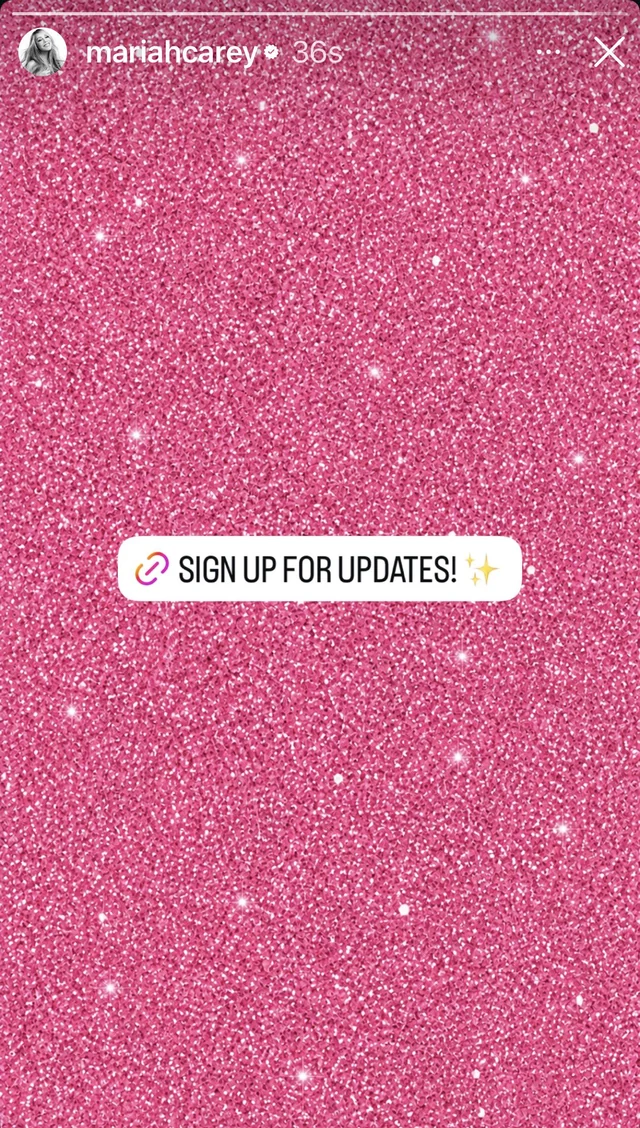
Carey has now posted an Instagram Story featuring a glitter-covered background and a simple invitation to “sign up for news” — hardly an official announcement, but about as subtle as a disco ball when the album fans have been waiting to hear about is called Glitter.
The timing is particularly suggestive.
Earlier this year, Glitter disappeared from streaming platforms, immediately raising questions among fans about whether licensing issues were involved or whether its removal was connected to the approaching 25th anniversary. Carey subsequently confirmed that plans were being discussed for a deluxe edition, a reissue, or potentially some combination of the two.
Now, the anniversary project appears to be pointing towards August 21, several weeks ahead of the soundtrack’s original September 2001 release date.
Nothing resembling a complete tracklist or physical-edition announcement has yet materialised, but the pieces are beginning to fit together: the streaming disappearance, Mariah publicly acknowledging plans for Glitter, rumours of archival material, growing talk of multiple vinyl editions and now a conspicuously glittery mailing-list tease.
For Lambs, the question is rapidly changing from is something coming? to how big is Mariah planning to make this?
From punchline to cult classic
It is difficult to understand the mythology surrounding Glitter without remembering just how disastrous its original era appeared to be.
The soundtrack arrived on September 11, 2001, one of the most traumatic days in modern American history. The accompanying film followed shortly afterwards, at a moment when entertainment promotion had understandably become almost irrelevant.
Carey was also experiencing a highly publicised period of physical and emotional exhaustion during the campaign.
The circumstances would have been punishing for any project.
But Glitter rapidly became something larger than an underperforming soundtrack or critically disliked film. It became a media narrative about Mariah Carey herself.
The movie was savaged by critics. The soundtrack debuted at No. 7 on the Billboard 200 — hardly catastrophic by normal standards, but treated as an extraordinary collapse for an artist whose previous decade had been defined by multimillion-selling albums and No. 1 singles.
Even “Loverboy,” which reached No. 2 on the Billboard Hot 100, became folded into the larger story of failure.
Carey’s enormous Virgin Records deal subsequently unravelled, and Glitter became culturally synonymous with the idea that one of the most successful recording artists of the 1990s had suddenly fallen apart.
For years, Carey herself largely kept her distance from the project.
Why the music endured
The strange thing is that the music aged considerably better than the scandal.
Built around an early-1980s aesthetic years before contemporary pop’s fascination with retro synths and disco revivalism, Glitter contains some of Carey’s most interesting vocal and production work: the euphoric “Loverboy,” the extraordinary vocal showcase “Lead the Way,” the emotional “Never Too Far,” the understated “Reflections (Care Enough),” the Rick James-penned “All My Life,” and her cover of Indeep’s 1982 club classic “Last Night a DJ Saved My Life.”
Separated from the movie and from the media circus surrounding its release, the soundtrack gradually became easier to hear for what it actually was.
Then Mariah’s fans decided to rewrite the story entirely.
#JusticeForGlitter changed everything
In November 2018, seventeen years after the original release, fans launched #JusticeForGlitter.
What initially looked like another affectionate fan campaign became something far more consequential.
Lambs began encouraging one another to buy the album digitally. Social media filled with posts celebrating songs that had spent years overshadowed by the film. Suddenly, an album widely remembered by the general public as a commercial catastrophe started racing up the charts.
Glitter reached No. 1 on the U.S. iTunes albums chart.
Carey joined in, enthusiastically embracing the campaign and finally appearing comfortable celebrating an era she had previously treated almost like forbidden territory.
The symbolism was impossible to miss.
An album once used as evidence that Mariah Carey’s career was finished had been dragged back to No. 1 seventeen years later by the very fans who believed history had judged it unfairly.
It also forced a broader reassessment.
Was Glitter really the musical disaster people remembered?
Or had a perfectly respectable — and in places excellent — Mariah Carey album become collateral damage in a much larger celebrity pile-on?
The album has sold more than two million copies worldwide, hardly the numbers normally associated with a record routinely described as though nobody bought it at all.
In the United States, the RIAA certified Glitter Platinum in 2001 for one million units. That remains the album’s most recent RIAA certification.
Twenty-five years later, the question of what a major anniversary campaign could do to its catalogue sales is therefore rather intriguing.
Especially because fans have already demonstrated what they can do with Glitter when nobody is actually promoting it.
The disappearance from streaming was the first real clue
When Glitter disappeared from streaming services earlier this year, fans noticed immediately.
Catalogue albums can disappear for all sorts of mundane reasons: licensing changes, distribution agreements, rights transfers or metadata issues.
But Glitter disappearing during the year of its 25th anniversary was always going to attract attention.
Then Mariah herself confirmed that something was happening.
Asked about the album and its absence from streaming, Carey acknowledged discussions surrounding a deluxe edition and reissue, making it considerably harder to dismiss the removal as an unrelated technical issue.
That does not necessarily mean the album was deliberately taken down as part of the campaign.
But the sequence is certainly suggestive.
And now there is the Instagram Story.
A glitter-covered image.
A request to sign up for news.
In August.
With an anniversary project apparently approaching on August 21.
At this point, Mariah could probably post a picture of a completely unrelated sequinned handbag and half the Lambily would start searching its metadata for catalogue numbers.
But this particular tease feels considerably less accidental.
August 21 could be the beginning of the real victory lap
If August 21 is indeed the release date, it means the anniversary campaign may arrive several weeks before Glitter technically turns 25.
That would actually make commercial sense.
Rather than releasing the project on September 11 — a date forever associated with events vastly larger than a pop album anniversary — an August release gives the campaign room to exist on its own terms.
It would also allow Mariah and her team to spend the following weeks celebrating the album rather than attempting to turn September 11 into a promotional event.
Most importantly, it creates the possibility of an actual coordinated launch.
Because Glitter has something many catalogue anniversary projects would kill for:
pent-up physical demand.
The vinyl has become absurdly expensive
Finding Glitter on vinyl at anything approaching a normal retail price has become increasingly difficult.
Standard retailers have not stocked official pressings for years. Meanwhile, copies on the secondary market routinely appear for hundreds of dollars.
Depending on pressing and condition, resale prices have climbed beyond $300, with particularly optimistic sellers asking substantially more.
That makes an anniversary vinyl reissue almost painfully obvious.
There are plenty of fans who want the album on vinyl.
There are plenty of collectors who did not buy vinyl when previous editions arrived.
And there are plenty more who simply refuse to pay $300 or $400 to a reseller for an album that could be repressed for a fraction of that price.
Rumours currently suggest that the anniversary campaign could involve several vinyl variants.
If true, that would be entirely consistent with the modern anniversary-release model: coloured vinyl, retailer exclusives, alternate packaging and deluxe configurations designed both for collectors and for fans who want one reasonably priced copy after years of staring at Discogs listings in horror.
For Glitter, that demand could be substantial.
Which brings us to the part where Mariah’s team can either make chart obsessives extremely happy or drive them completely insane.
Please, for the love of Glitter, ship everything in the same week
A coordinated chart opportunity
There is a genuinely interesting commercial opportunity here.
If the expanded Glitter edition lands digitally and returns to streaming on August 21, the strongest possible strategy would be for the vinyl and other physical formats to ship during the same chart tracking week.
Not simply go on preorder.
Actually ship.
That would allow physical album purchases, digital sales and streaming activity to hit simultaneously.
Multiple vinyl editions could produce meaningful collector sales. A deluxe digital edition could attract purchases from fans interested in the bonus material. And Glitter returning to Spotify, Apple Music and other services after months of absence would inevitably generate a burst of streaming activity.
Then add the publicity surrounding the 25th anniversary itself.
For an album whose history is so intimately connected to the perception of commercial failure, there would be something wonderfully poetic about Glitter suddenly producing a significant Billboard 200 week a quarter of a century later.
Why a comeback could work
And there is precedent.
#JusticeForGlitter put the album back at No. 1 on iTunes without a major label campaign, anniversary package, vinyl variants or a coordinated promotional push.
Imagine what could happen if this time everybody actually tried.
Of course, that assumes Mariah still cares about charts.
And this is where experience teaches us not to get carried away.
It is entirely possible that the expanded edition arrives on August 21, five vinyl variants go on preorder the same afternoon, the CDs ship in October, the first vinyl appears around Christmas, another materialises mysteriously in February and the prettiest variant finally turns up in March 2027.
Mariah will meanwhile be somewhere saying, “But darling, the vinyl is beautiful.”
And she will not be wrong.
At this stage of her career, Carey has little left to prove commercially. She already has nineteen Billboard Hot 100 No. 1 singles, decades of catalogue success and a Christmas standard that returns to the top of the charts with almost supernatural regularity.
Perhaps maximising one week of Glitter sales simply does not matter to her.
But if ever there were an album for which a perfectly coordinated chart week would feel satisfying, this is it.
What could actually be on the deluxe edition?
The physical editions are only half the story.
The more interesting question is what Mariah is planning to put on them.
What fans could hear
Fans have discussed several possible pieces of bonus material. However, nothing is confirmed until an official tracklist appears.
One of the most tantalising rumours concerns an a cappella version of “Lead the Way.”
For vocal fans, that would immediately become one of the centrepieces of the release.
“Lead the Way” already contains one of the most formidable recorded vocal performances of Carey’s career. An isolated or specially prepared vocal version would give listeners a chance to hear the arrangement, layering and extraordinary sustained climax without the production surrounding it.
There are also rumours of previously unreleased “Loverboy” remixes.
That song alone has enough complicated history to justify archival attention.
Carey originally intended “Loverboy” to incorporate Yellow Magic Orchestra’s “Firecracker,” before circumstances surrounding the sample forced her to rework the song around Cameo’s “Candy.” Carey eventually released the original “Firecracker” version on The Rarities in 2020. Fans could finally hear a major missing piece of Glitter history.
If further unreleased mixes survive, the 25th anniversary would be the obvious place for them.
Rumours have additionally suggested live performances from the era.
Again, completely plausible.
Mariah’s anniversary projects have increasingly incorporated live recordings and archival material rather than simply remastering the original album and calling it a day.
But the thing many fans will inevitably be hoping for is more ambitious.
Give us an unreleased song
An unreleased Glitter-era song would immediately elevate the project.
Alternate versions and remixes are wonderful for collectors, but nothing generates excitement around an archival release quite like a genuinely unheard Mariah Carey recording.
And if history has taught us anything, it is that Mariah’s vault is rarely empty.
The Rarities revealed songs and alternate recordings fans had spent years wondering about — and others they did not even know existed.
The Glitter sessions took place during an enormously productive period in Carey’s career. Whether a fully finished and releasable unheard song remains from those sessions is unknown.
But it is difficult not to hope.
Twenty-five years is a long time to wait for justice.
Throw us a song, Mariah.
Glitter no longer needs defending
Perhaps the most interesting thing about this anniversary is that Glitter no longer really needs rehabilitation.
That work has already happened.
The album survived the film, the reviews, the endless jokes and its transformation into convenient shorthand for a celebrity breakdown. It even survived years in which Mariah herself seemed reluctant to revisit it.
Then the fans changed the story.
They rediscovered the soundtrack, defended it and turned #JusticeForGlitter into one of the most memorable catalogue revivals of the social-media era. In 2018, Glitter returned to No. 1 on iTunes, forcing a wider audience to reconsider the music separately from the film and the tabloid mythology surrounding its release.
Mariah eventually joined them.
Since then, new listeners have found the album through streaming, The Rarities finally delivered the original “Loverboy” version, and Carey has grown increasingly affectionate towards an era she once seemed happy to leave behind.
That is why a 25th-anniversary edition does not need to rewrite 2001.
The era was chaotic. The film was poorly received. The album underperformed relative to Mariah’s extraordinary commercial standards. All of those things can be true without determining whether the music itself was good.
And twenty-five years later, Glitter has finally escaped the burden of having to prove that distinction.
Now, in 2026, the soundtrack has disappeared from streaming, Mariah has openly discussed a deluxe edition and reissue, physical copies have become prohibitively expensive, rumours are circulating about unreleased material and multiple vinyl variants, and she has suddenly posted a glitter-covered Instagram Story directing fans to sign up for news.
With August 21 emerging as the apparent arrival date, this no longer feels like distant anniversary speculation.
The rollout appears to have begun.
The remaining questions are how extensive the release will be, how far Mariah is willing to open the vault and whether the physical and digital editions will be coordinated well enough to give Glitter one spectacular week of sales.
Or perhaps nobody involved cares about any of that and we will all be receiving our vinyl in March.
Either way, one of the strangest chapters in Mariah Carey’s catalogue is about to be reopened.
And after twenty-five years, Glitter does not need justice anymore.
It deserves a coronation.